Monday, November 24, 2008

What do kids really think of their fathers?

Published www.iberkshires.com & The Advocate - June 18, 2004

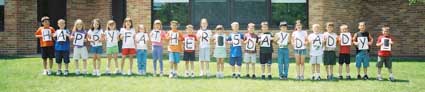
Happy Father's Day

First-grade students in Judy Bercury's class at Craneville School in Dalton have a message for fathers.

"When I was a kid, I used to imagine animals running under my bed. I told my dad, and he solved the problem quickly. He cut the legs off the bed."

- Lou Brock

Dads have traditionally been the "fixers." From the broken toaster to monsters in the closet, dads have always known just what to do to make everything right.

With Father's Day rapidly approaching, I thought dads might like to know just how significant a role they actually play in their children's lives and how little escapes their children's notice. In Dalton and Hinsdale, with great help from Craneville's first and second graders, Kittredge's kindergarteners and Kathy's Corner Daycare kids, along with their teachers and caregivers, Kathy Cormier, Judy Bercury, Suzanne Drury, Patricia Geller, Marge Morrison, Marcia Koperniak, Amy Abramovich, and Christine Verge, I found a few answers.

Do not let those glazed eyes and vacant expressions fool you: Kids are watching more than television and computer screens. When asked the questions, "What does your dad know best?" and "What has your dad taught you?" children had the following written answers - some original, some comical and some thought provoking (particularly regarding phonetic spelling) - and some Mom might not like to know:

What does your dad know best?

"How to do cartweels in the Fourth of July praed." - Jamie D.

"How to let off fireworks. Last summer, he let off all the fireworks." - Dylan S.

"How to whistle." - Samantha G.

"All about me." - Abby D.

"How to work best." - Angel.

"How to cownt to 100." Sydney S.

"How not to watch a lot of TV and to catch bugs like buterflys and worms. He knows how to keep me cumpny." - William O.

"How to make money at Cranes. He makes the dollars." - Brenna V.

"To cepe me shafh." (keep me safe) - Jeffrey V.

Bridget L. said she and her sisters were very proud of their father because, "Dad knows best how to open the pool on a hot hot day."

Possibly much to their mothers' surprise, it seems many dads know how to cook best, according to the children. For example, they know how to make "omlits" and "brakfist."

They also know a little bit about automobiles, such as:

"How to make a car." - William L.

"How to fix cars in one minute because he has lots of practice." - Michael S.

"How to drive a jeep and not do a sped lemet." - Joseph E.

Allie G. said her dad knows best "that wen I had to bye a rake for mother's day, my dad new where it was." (Note to Allie's dad: We know you'll love the new frying pan Allie's mom is planning to buy you this Father's Day.)

Taylor F. from Mrs. Bercury's class summed the whole question up for many, however:

"How to love me; how to take care of me and how to remember."

What is the most important thing your dad taught you?

"Stay away from the concrete." - Dalton, whose father is in the concrete business.

"Never talk to strayders and never go with strayders." -Jamie D.

"Everything I am now." - Nicholas.

"My dad taught me how to ski. He helps me up when I fall and he tells me to keep trying. Now I know how to ski." - Caitlin M.

"My dad taught me to be a good soccer player. But I still have prablms with my left foot. But I love him." - Katherine L.

"My dad has taught me how to play badmitten because I aked him to. That is whe I think he is a great Dad. And I love him very much." - Bethany H.

"My dad taught me to climb trees." Connor V.

"My dad taught me never say swear words and never move a video camra fast and never play with a scorpion."- Brandon R.

"My dad taught me how to say: Supercalifragilisticexpialidocious and his name is Scot."- Jocelyn L.

"To try new food like sooshy." Allie G.

"Not to pick up snakes. - Kaylena.

"How to tel the trooth and do a hand stand." - Sean K.

"My dad taught me a lot of songs like 'Country Road' and 'Imagine.' He taught me what was right and wrong. My dad gives me good advice." - Tiffany R.

"How to count money." - William.

"The chores have to get done or my mom yells." - Mike.

So, yes, dads, your kids probably do realize you haven't bought stock in the electric company, you have no desire to heat the outdoors and money doesn't grow on trees. They all no doubt appreciate that you taught them how to ride a bike, throw a ball, read a book, tie their shoes, use a fork, bait a hook, swing, share, "not to be scard of the dark" and "not to throw stuff."

And they really are listening, paying attention and, especially, watching you.

Monday, November 17, 2008

Making Hay While the Sun Shines


Published September 2005 The Advocate

Knowing trees, I understand the meaning of patience. Knowing grass, I can appreciate persistence.” Unknown

Lenox - “It all depends on the weather, and you can’t depend on the weather,” Phil Rennie said at a recent interview as he got ready to complete his haymaking for the summer.

Phil Rennie and Paul Cella, of Lenox, start their three-day competition not with a waving green flag, but with a field of waving green grass. They race, not against each other, but against a much stronger and more unpredictable adversary – the weather. Enough rain to make the field of Timothy grass grow high enough for haying is needed throughout the spring and summer. Three dry days and nights in a row are then needed to cut, dry and bale the hay to be stored in the barn for the coming winter.

In June and August almost every year for the past 15 years, Rennie and Cella have driven in circles over a 4 acre field owned by a neighbor on Holmes Road in Pittsfield. The field is one of the few undeveloped pieces of property left on that road.

Their maximum speed is less than five miles an hour. They don’t wear helmets or seatbelts, but they do make sure their boots are tied, and their sleeves are buttoned so nothing can be sucked into the machinery, causing injury.

“I’ve heard of farmers who have lost arms or legs because their shirt sleeves were too loose,” Rennie said.

Rennie and Cella don’t have wealthy sponsors or screaming fans. Their only audience is of the winged and four-legged variety - hawks, field mice and moles, and sometimes, Rennie’s 15-year-old terrier mix, Benji, who likes to play in the field.

“The moles come out because they hate the vibration of the tractors, and the hawks sit in the treetops and wait for lunch,” Rennie said.

On the first day, Cella, driving a 1948 white Oliver tractor and Rennie, driving a green 1966 Oliver tractor, both tow sickle haybines around the field. The blades of the haybine cut the grass and the circular motion pulls it through large black rollers to squeeze some of the moisture out. It then lays in the field overnight.

Tedding, the process where a tedder towed behind the tractor spreads and shakes up the grass to help it dry, usually done on the second day, wasn’t necessary this time because there had been so little rain in the month of August. Rennie said they usually get the tractors stuck in the far end of the field because it’s so swampy, but that wasn’t a problem this year.

The third day, at about 11:00 a.m., after the dew had dried, Cella towed a hay rake and windrowed the cut grass into circular rows about ten feet apart. This allows the cut grass to “catch the wind” and dry more quickly. If the grass was at least three feet high, he would have driven in a clockwise circle and pushed the rows to the outside of the field. Since the grass was only a foot high before this August cut, he drove in counterclockwise circles and pushed the grass to the inside of the field. Double “windrowing” works well to make larger piles when the grass is sparser. Larger rows mean fewer passes and less work for the baler, which will follow.

Once all the grass in the field has been piled into rows, Rennie drives his tractor, towing the baler, kicker, and hay wagon from his house on East Street in Lenox around the corner to Holmes Road and down into the field. The length from the front of the tractor to the back end of the wagon is 54 feet long. Turning the corner, Rennie is on both streets at once, while oncoming traffic in both directions on Holmes Road patiently waits.

Once Rennie reaches the field, he drives the tractor over the rows of hay, where it is sucked up into the baler, compressed into square bales and tied, by the machine, with twine. A plunger pushes each tied bale to a stainless steel square plate, called a kicker, which tosses the bales high into the air and into the back of the hay wagon. The kicker can be adjusted as the back of the wagon becomes full, to kick the bales to the front of the wagon. A counter keeps track of the number of bales kicked into the wagon.

Rennie, who has owned and run a lawn care and fertilizing business, The Lawn Doctor, for the past 17 years, does no fertilizing of the Holmes Road field, allowing Mother Nature to determine the height of the grass.

“Sometimes we bale a few weeds too, but a little roughage won’t hurt the horses. They won’t touch the goldenrod though, so you have to stay away from that,” he said, pointing out a large patch of bright yellow weeds growing at the far end of the field.

The grass, after a rainy spring, was about four feet tall for their first cut in June, which produced about four hundred 35 pound bales of hay. The second cut, at the end of August, after a summer of little rain, was only a foot high and produced only 110 bales of hay. Their “winnings” at the end of this race will be enough to feed Rennie’s three “pet” horses, Willie, Misty and Laura Lou and Cella’s horse, Gold Man when the grass stops growing in November. The hay supplements their diet of grain and occasional treats of apples and carrots.

Rennie, who bought his mother’s house, adjacent to the Holmes Road field and just over the town line in Lenox, in 1981, has lived most of his life in Lenox. Married for 34 years on October 23, 2005, to Hania Gardner of Pittsfield, he has two daughters, Kristin, a veterinarian who lives in New Hampshire and Kendra, a federal probation officer in NY. Kristin’s ten month old son, Theo, is Rennie’s first grandchild. He has owned horses all his life and first learned to cut hay with his grandfather, when he was just five years old.

“It was a lot more work back then,” he said, “In the old days, we cut it with a sickle and it would just plop on the ground. We would pitch fork it into piles and load it by hand into a wagon pulled by a horse. Then you’d pay somebody about a $1.00 an hour to jump up and down on the hay to pack it down. What used to take 15 people three days to do, can now be done in the same amount of time with just two or three people.”

“Before we had the hay wagon and the kicker, I used to buy beer for the neighborhood guys, and they’d go around the field and throw the bales onto the back of pickup trucks and help us load it into the barn. It was cheaper [for them] than joining a health club,” he said, “One guy even got mad at me for buying the kicker. He liked the workout,” Rennie said with a laugh.

The process of making haying, in addition to being ruled by the weather, can be disappointing or even dangerous. The hay cannot be cut, baled and stored in the same day because hay that is too damp will grow toxic mold, which makes it useless as livestock feed since it could kill or cripple a horse. Worse, hay packed into bales and stored too wet can spontaneously combust, which has, according to Rennie, caused most of the barn fires he’s seen.

The best feeling in the world, Rennie said, is when the hay’s all in. For him, it’s three days of peace and quiet in a sunny field where the only sounds are the drone of the tractor engine and the occasional scolding of crows. “I just like being outside,” he said.

Rennie prefers the square bales to round. He said the equipment needed to roll the hay into those big “marshmallow” shapes, is too expensive for him to justify the cost.

“The round ones are heavier and harder to handle. I think there’s more waste in the round, and I don’t think the horses like them as well. If you don’t have any help, though, round is the way to go because you can pick them up and move them with a tractor.”

Though no one applauds or sprays them with champagne when they both cross the hay making finish line at the same time, Rennie has had a corn roast the Sunday before Labor Day every year for the past 34 years. Attended by 200 people, (some of whom the Rennies don’t know, but welcome nonetheless), they buy 400 ears of corn from Whitney’s Farm in Cheshire, Massachusetts.

“It gets bigger every year. Everybody brings a dish, and we can cook 40 ears of husked corn at a time in a rack over an open fire. It takes two guys to flip the rack, and you’ve never tasted corn as good,” he said.

It wouldn’t be a real Rennie picnic, of course, without hayrides. Throughout the day, the hay serves double duty as seating for all the Rennie’s guests. From the oldest to the youngest, no one misses the chance to climb up on the hay wagon for a ride as Rennie puts his tractor to use one last time, celebrating another successful hay making season, family, friends, and the official end of summer.

Thursday, November 6, 2008

Waiters dish out realities of the service industry

Published: June 9, 2005; The Advocate & http://www.advocateweekly.com/

“Will you marry me?”

“How did you lose your thumb?”

“Could you send that girl a pink lemonade from me?”

“Can I have your phone number?”

“Have you seen my dentures?”

Along with tips, these are just a few of the tidbits servers at local restaurants have collected from customers over the past few years.

From the other side of the table during recent interviews, Applebee’s servers, Sharon Croshier, Joshua Crawford and Brett Jalbert, along with Zucchini’s employees Todd May and Crystal Czerno, dished up their experiences and a few embarrassing moments in the restaurant business.

The National Restaurant Association estimates that four out of every 10 adults have worked in the restaurant industry at some time during their lives, and 27 percent of adults got their first job experience in a restaurant. The restaurant industry, employing an estimated 12.2 million people, is second only to the government as an employer, according to the association’s Web site, http://www.restaurant.org/.

Crawford, Jalbert and May are full-time college students, working to pay tuition. Crawford and May are business majors and Jalbert is studying structural engineering. They all plan to keep their current jobs on a part time basis after graduating. Croshier, mother of an 11-year-old daughter and 6-year-old triplets, appreciates the flexible schedule and being able to go home in a good mood every day. Czerno, whose mother is also a food server, has worked in the restaurant industry since she started bussing tables at age 13 and hasn’t yet decided on a future career.
None of the five is pursuing a career as a singer. Their most embarrassing moments in their current jobs include singing happy birthday to customers.

“None of us can sing,” May said.

Crawford admitted to a lack of singing abilities as well, but one of his most embarrassing moments came when he took a stab at comedy.

“I went to take a plate from a customer, and he said he wasn’t quite done,” Crawford said. “Holding my hand up with my thumb tucked into my palm, I said, ‘Oh sorry, good thing I didn’t take it. I already lost one of my thumbs.’ And [the customer] said, ‘that’s funny, I lost my thumb ice fishing; how did you lose your thumb?’ He really had lost his thumb, and I felt like the biggest idiot. I excused myself to go get my foot out of my mouth and apologized profusely for the next half hour. At the end of dinner, his wife gave me a hug and said it was the most fun she’d ever had in a restaurant.”

“Josh is a bit of a goofball,” Applebee’s general manager, Billy Greer, said, “but we encourage that here because we want our customers to have fun.”

With over 900,000 eating establishments generating an estimated $476 billion of sales every year, restaurant patrons must be having fun. The National Restaurant Association estimates the average household expenditure for food away from home in 2002 was $910 per person. Food servers typically earn $2.63 per hour.

“It doesn’t sound that bad until you say it out loud,” May said.

“But at least it covers income taxes,” Croshier added.

“Some weeks their paychecks are so little they don’t bother to pick them up,” Greer said.

These minders of the tables, servers of food and sometimes finders of the false teeth that are inadvertently left behind after a meal, work for their tips. Though they never know from one day to the next how much money they will take home, they all agree that the instant feedback of a great tip for doing a good job is an incentive to do their job well – and a bad tip merely motivation to make improvements. The hard part, they said, is that they can’t predict or depend on a certain level of weekly income.

Croshier, who admits she lives for challenges, doesn’t think raising wages and eliminating tips is a good idea, however.

“It’s fun to earn a good tip,” she said. “It’s almost like gambling – waiting on tables is a high, and I love it. It’s up to me to make the money I need.”

Czerno said, “When you’re on your own, living in the real world, and it’s been a slow week, you start to stress and say to yourself, ‘I’d better get my game on quick, rent’s due next week.’”

Jalbert said, “Yesterday, I was ruthlessly, horribly sick, but you can’t get sick. I spent my last $10 yesterday, so I got sleep and took [my medicine} because I needed to work today.”

Crawford added, “Tips are everything. Keeping your chin up after you get a 5-percent tip is hard. You want to ask what you did wrong, but you can’t. You swallow it and go on, and maybe the next customer doubles your tip. I’ve seen people who watch another customer giving the server a bad time and try to make up for it with a bigger tip.”

May agreed that it’s hard to predict a size of a tip.

“You can completely misjudge whether or not they’ll leave a good tip, and for the most part, you can’t tell. I think people tip no matter what you do. Some people are brought up to tip 10 or 15 percent; some people bring in their calculators. Others will throw down a $20 for a $40 meal without giving it a second thought.”

Determining the size of a tip may not be possible, but servers do develop skills in evaluating and anticipating what people need and want, sometimes before they ask for it.

“The biggest part of being a successful server is learning to read faces and body language,” May said.

Czerno said it’s awkward when people come in fighting or having a bad day.

“You try hard to give them their space. I don’t see that he’s yelling at her and she’s crying, and they’re choking down their food. I don’t see that.” But, she added, “If there’s something wrong with the food or service and I don’t see that, please tell us.”

An only child, Crawford admits to little experience with young children. At 6 feet 2 inches tall, he has learned that bending down to eye level of the younger customers and giving them choices too, is appreciated, not only by the kids, but also by their parents.

Croshier said she waits on tables the way she would expect to be waited on. “If I’m eating messy wings, I would like extra napkins. If I’m halfway down on my drink, I would like another one before I have to shake my glass around wondering where you are, and I would never ever forget the silverware. Those little things are important, and you remember them when you do it day in and day out – or at least you should.”

Jalbert said learning to read faces has helped him develop his poker skills, but he admits that remembering to bring silverware to his tables is still a challenge. He and his co-workers laugh and excuse his shortcomings with some good natured teasing.

“He’s tall, so he hits his head on the Tiffany lamps a lot,” Greer laughed.

“They’re cast iron,” Jalbert added. “That hurts.”

Because both restaurants serve alcohol, their servers are also responsible to stop serving an inebriated customer. Applebee’s had an incident with a woman trying to hang from one of its Tiffany lamps after a few too many drinks.

Croshier said, “You can’t allow that. This is a family restaurant, and the other customers don’t want to see that.”

May said that, in his experience, people know when they have had too much and don’t usually get upset with the server when they have to stop serving alcohol.

All five agreed their co-workers and regular customers are their extended families and like any normal family, conflict and occasional clashes occur.

“I can be bossy,” Croshier admitted. “Because I’m a mom, I sometimes treat my co-workers like my kids.”

“We’re human,” Crawford said. “There are sometimes problems with a co-worker, but you don’t bring it into the dining room – you put on a happy face and do your job and we’ll talk about it when your shift is over.”

Greer added, “Everyone has off days and if it’s really bad, there’s a soundproof freezer in the back where you can go to scream and punch a box of French fries.”

Problems with co-workers pale in comparison to the stress of dealing with the public. Customers are allowed to be rude, condescending, demanding or just downright cranky, but dropping drinks on customer heads is never acceptable server behavior. Smiling and being polite no matter what is the golden rule for servers.

According to the serves and managers, customer complaints are almost never about service. Customers hate waiting more than anything, which may be a result of a society geared more and more to instant gratification.

Crawford observed, “One customer can’t see that I’m doing 32 other things right now. They only know their glass is empty, and they’re thirsty.”

Because they’re human, servers do get frustrated with customers. Among their pet peeves are customers who yell, snap their fingers, clap their hands or refuse to make eye contact and ignore them. May summed up the main feeling of every server, with a simple sentence, “I’m here to serve you, but I’m not your servant.”

The worst customer, of course, might be a fellow server. They all regularly go out to eat at different restaurants in the county. Croshier said she’s very critical when she eats at another restaurant, always measuring the service against her own high standards. Crawford said he likes to challenge servers by asking for “weird concoctions.”

Czerno, on the other hand, said “I would love to wait on me….it drives me crazy when I get bad service, but no matter what, I tip 20 to 30 percent because I know what it’s like to work for tips.”

Tired of cooking, weary of washing dishes, or perhaps in celebration of a special occasion, every American has probably graced a restaurant table at least once. Balancing drinks and serving food might seem deceptively easy while perusing a menu from a comfortable seat, but service with a smile is only a small part of the job of a server.

Marketing, memorizing, matchmaking, and mind reading are necessary skills, too.

“Just treat people the way you would want to be treated.” Croshier advised. “And don’t take things too seriously.”
Wednesday, November 5, 2008

For Nurse couple, love and expertise heal all wounds

Published: November 24, 2005 - The Advocate Weekly & http://www.advocateweekly.com/


When asked to guess their occupations, most people assume Bill Ahern is a truck driver, a mechanic or a plumber and they often, even without invitation, ask his wife, Brenda Ahern, if she is a nurse, because she “looks like a nurse.”

They are half right. Brenda and Bill Ahern are both registered nurses.

According to the U.S. Department of Labor, less than 10 percent of the more than two million RNs in this country in 2004 were men. Though strangers are surprised by Bill Ahern’s occupation, their reactions have always been positive. His friends and family, however, sometimes use his profession to give him a hard time. While helping his brother-in-law build his house, he was given the job of pounding 3-inch spikes into the concrete foundation.“I might be a nurse,” he said recently, “but I can pound a nail. I used to build Shaker tables and do basic carpentry, but I hadn’t ever done this before, and I kept bending the spike. One of the other guys yells, “’Hey get the nurse off that job.’”

Although he does not resemble Florence Nightingale in any way, Bill Ahern has worked within the medical community for the past 17 years. He started at Hillcrest’s dietary unit at age 16. After joining the National Guard infantry at age 19, he attended Berkshire Community College part time and continued to work at Hillcrest as a radiology transport aide and darkroom technician, and an operating room orderly, where patients often mistook him for a nurse. He also worked as an anesthesia technician at Crane Center/BMC’s operating room.

When someone first suggested he become a registered nurse, he scoffed at the idea, then realized he had completed all the prerequisite courses necessary to enter the nursing program at BCC.
Recalling his grandfather’s advice to “build on what you know,” and searching for a new challenge, he entered the program. While enrolled in the RN program at BCC full time, he worked at Berkshire Medical Center’s Dialysis Unit as a Reuse Tech and trained as a hemodialysis technician. Once he qualified as a registered nurse, he joined the Dialysis unit at BMC in the Medical Arts Complex in 2001.

Brenda Ahern, on the other hand, did not enter the nursing program until after she married four years ago, but she had considered a nursing career from the time she was a child. When she and her future husband met, she was also taking part-time classes at Berkshire Community College to become a medical assistant, and worked at Lenox’s Yankee Inn and for the advertising department at the Berkshire Eagle. Upon completing her training, she worked at Lee Family Practice as a medical assistant and phlebotomist. In 2000, she joined BMC as a medical assistant at its Neighborhood Health Clinic, while completing her prerequisites for the nursing program at Berkshire Community College. When she was accepted into the RN program, she also worked part time as a unit secretary, at BMC’s Jones-2 and as a nursing assistant in telemetry.
She became a registered nurse in 2004, and said she feels she didn’t choose the profession as much as it chose her.

“I transferred my position to nursing assistant on [Berkshire Medical Center’s] 5 West while going through the nursing program, and I felt comfortable here. It’s an honor to be there with the patients and their families, but it’s tough too,” she said. “Patients have said to me, ’How do you do this? This is a thankless job.’ But when I’m cleaning someone up or helping someone out, I like to think that someone would do it for me – that’s how you get through the hard parts of the job.”

Her husband agreed. His first “hands on” experience as a nurse-in-training was what those in the nursing profession delicately refer to as a “code brown” situation (cleaning up diarrhea). It did not deter him from his goal, however, and he still takes it all in stride.

Recalling a recent experience with a patient who kept apologizing for the situation, he joked, “Well if the shoe was on the other foot, you’d do this for me wouldn’t you? And the guy looked right at me and said, ‘no!’”

Combined with compassion, the Aherns both contend a sense of humor is absolutely necessary not only to connect with their patients and give them the best care, but to maintain the ability to love the job even on the days when they can’t seem to make anyone happy. Perhaps more than most jobs, nursing can be emotionally, mentally and physically draining, but most of the time, the couple can count on each other for support. However, being in the same occupation also has its drawbacks.

“It’s a double-edge sword,” Benda Ahern said. “I feel lucky that we’re both in the same profession because I’ve had nurses say, ‘My husband just doesn’t understand what I do.’ A lot of guys might say, ‘Well, you didn’t do a roof all day,’ but Bill knows how hard it is [to be a nurse] because he does it too.”

On the other hand, there are some days where one of them will want to vent, and the other one wants to forget about it.

“Some days I come home, and she’ll want to talk about it, and I’ll say, ‘Oh yeah? You think your day was bad? Well, listen to this,’” Bill Ahern said.

His wife replied that they occasionally face days that inspire dreams about leaving the profession, buying an inn in Vermont and opening a quilt shop.

In spite of the difficulties, both nurses said they most appreciate the aspects of the job that allow them to interact on a daily basis with a wide variety of people and personalities. Both feel the most important skill in nursing, aside from technical knowledge, is to learn to adapt to every situation, leaving any inclination to make judgments about anything other than a patients’ health and comfort outside the door.

“Every room that you walk into will be a whole different situation, and you have to figure out how to switch from one person to the next,” Brenda Ahern said. “You can’t be judgmental because you can never know why people are the way they are or how they got to this place in their lives.”

When admitted to a healthcare facility, patients may make judgments of their own, of course. Placing faith in the professionals who care for them, they often give up a certain amount of control, not to mention a bit of their dignity. Neither Ahern, however, has ever encountered patient prejudice because of their gender, and both frequently receive compliments about the other’s skills from patients they have in common.

“I’ve seen my husband interact with the patients, and he immediately puts them at ease; he is very gentle, very very patient and very kind,” Brenda Ahern praised.

Based on their experiences personally and professionally, though, both acknowledged their own stereotypical assumptions and expectations, especially about themselves and each other. Bill Ahern believes male doctors relate differently to him than they do to female nurses.

“When a doctor gets upset,” he said, “and yells because something is missed or isn’t done right, I interpret that as “Hey dude, c’mon.’ It motivates me to do a better job, where Brenda would probably take it more personally.

She didn’t disagree, and offered some of her own observations about the male of the species.
“He cut his finger with my manicure scissors while we were on vacation. I told him to be careful. I told him they were really sharp. He should have had stitches, but he wouldn’t go to the hospital. He used duct tape, which he carries with him everywhere we go. He’s a big baby when he gets a cold though.”

Despite, or perhaps due to, the responsibilities of their jobs, the couple said they are more appreciative of each other, and feel free to be as open and honest as the people they care for.

“When you’re seriously ill, you say exactly what you think,” said Brenda Ahern. “It’s freeing in a way. I always tell people, if something hurts, and they need to swear, I’m not offended – whatever they have to do to make themselves feel better, it’s okay.”

The job has changed their perspectives and attitudes about life in general, as well.

“When I’m upset over something like a boat part didn’t come in, and I need to put it on the damn boat, I’ll think about a patient I’m taking care of, and my problem is like nothing,” Bill Ahern said.

His wife added, “I realize that I get to go home and forget about it for awhile and lead my life. But they’re sick and can’t get a reprieve. It makes us more grateful and take things less for granted.”
The Aherns take seriously their roles as the people who assess and report, educate, advocate, and rehabilitate, hold hands and heads, reduce pain, promote healing, clean up, calm down, and provide comfort in even the most uncomfortable of situations. And as experts in their field, they have a unique understanding of nursing’s challenges and problems.

One of the biggest issues with regard to quality care, they said, is not a shortage of people eager to enter the field of nursing, but a lack of qualified nursing teachers and nurses available to give clinical instruction.

And although they have been discouraged at times, they are both grateful to have made it through the “fear phase” of nursing, where they began to believe they had the symptoms of every illness they studied; and the “honeymoon phase” of nursing when they believed perfection was possible. And they try to take care of themselves and abstain from becoming cynical about the illnesses they see all around them.

“People educate themselves more about buying a car than [they do] about their own health,” Bill Ahern said.

Brenda Ahern agreed. “Doctors aren’t God. Don’t be afraid to say, ‘explain that further’ or ‘I want a second opinion.’ The patients’ participation in overall heath care would help immensely.”


But leave the duct taping to the professionals.