Tuesday, December 2, 2008

Cuban emigre and artist spins the web of a lifetime


Published February 16, 2006, http://www.advocateweekly.com/ & The Advocate

Hinsdale MA - When she moved to the United Sates as a teenager, Josefina Speckert didn’t have family, friends, a home or any understanding of the English language to help ground her. Today, the busy therapist, artist and mother to many is woven into the tapestry of her community.

After immigrating, alone, to Miami, FL, from Cuba at age 15, Speckert was placed in an orphanage where she lived for almost two years.

“Those were the saddest moments of my life, the loneliness and the lack of nurturing and affection. That influenced the direction of my life,” Speckert said recently.

The direction in which Speckert traveled eventually brought her to 111 Pittsfield Road in Hinsdale, where she has lived for the past 10 years with her husband of nearly 40 years, her parents, a 7-year-old foster child and an uncounted number of pets and farm animals, many of which were rescue adoptions. Mother to five daughters and two sons (natural and adopted), grandmother to eight grandchildren and foster mother to so many children she has lost count, Speckert is rarely alone and doesn’t have time to be lonely these days.

In addition to running the family farm, she works four days a week as the Director of Behavioral Health and Substance Abuse at the Hilltown Health Center, and holds a part-time job as a clinical supervisor for the visitation program at the YMCA. She and her husband, Tom Speckert, the executive director of Goodwill Industries, also run Abi’s Web, a craft studio over their barn, which they opened in 1996.

Speckert was christened “Abi” by her grandchildren years ago. The nickname is a shortening of “abuela,” the Spanish word for grandmother. And, as weavers selling their craft, “web” was the perfect description of their new business, which turns the raw wool shorn from their farm animals – angora goats, Suri alpacas, Navajo sheep and a “guard” llama named Stewart, among others – into woven and knitted crafts. The Speckerts create their art throughout the year and sell mainly at wool festivals and local county fairs between April and September. In additional to their own handmade clothes, blankets, and rugs, they also carry crafts made by local artists on consignment and a plethora of spinning and knitting supplies – everything from New Zealand possum or soybean yarn to wood “nitty notties” (to skein yarn by hand) and antique spinning wheels, which Tom Speckert restores to working condition.

At a recent interview, amidst muffled braying, baaing, honking, crowing, quacking and giggling from the barn and the yard, Speckert sat at one of her many spinning wheels and explained her love of spinning as she worked the wheel with her hands and feet.
She began spinning in 1994 when her son, Steven, was diagnosed with a terminal illness. She became his primary caretaker and was looking for ways to relieve the everyday stress of the constant responsibilities.
“A friend said ‘you should start spinning; it’s very therapeutic.’” And I said, ‘OK, what’s that?’” Steven couldn’t move and couldn’t speak, but he could watch me spin for hours,” she said. Although she is a psychotherapist with a master’s degree in counseling from the University of Massachusetts at Amherst, she discovered that spinning not only calmed her, but also provided her with a creative outlet and a functional finished product. No one is ever cold at the Speckert household, thanks to the woolen products she creates from yarn spun nearly every day.
“It’s probably the most relaxing activity I can think of. If I told people how much better this is than psychotherapy, I’d be out of work,” she said with a laugh.

Speckert shares her mastery of knitting, spinning and weaving by running an open house and classes in her studio the first and third Monday of every month from 1 to 4 p.m.

“We have tea and cookies too,” she added.

A knitter since age 9, Speckert also practices the art of felting, where the raw fiber is wetted and worked together with the hands or feet until the hairs fuse to produce the felt material. There is a loom in the studio for weaving, as well, but she said that is her least favorite activity in the fiber art world.

“Tom does most of the weaving. He likes the complicated patterns best,” Speckert said.
She said she finds the weaving tedious and time consuming, requiring more planning and patience – not to mention mathematical calculations in creating a pattern – than spinning.

Speckert prefers working the fiber (unprocessed wool) instead of roving, (cleaned and processed wool). Fiber, when it has not been processed, carded or washed, is called “on the grease.”

“When you spin on the grease, you have a lot of lumps and bumps which makes for a more unique yarn,” she said.

Unique or “a little bit of a ‘60’s rebel” is also the way Speckert describes herself. She has a tattoo on each ankle and one on her forearm, each representing her birth place – the Cuban flag bordered by broken chains, a Cuban Bee Hummingbird (Mellisuga helenae) and a Cuban postage stamp from a letter her aunt mailed to her.

Her friends and family call her unconventional or weird, depending on their mood. Likewise, her husband, when given an art class assignment to draw the essence of the most important person in his life, drew a brick wall, cracked in the middle, to represent his wife.

Celebrating their 40th anniversary on April 15, the couple met while both were attending St. Louis University in Missouri. She was waiting for the bus and saw him walking down the street. She said “hi” and asked him to hold her books while she went into a nearby store to buy a soda.

“I just grabbed something out of the cooler and when I got back out there, I realized I had bought an orange soda. I have never before, or since, drunk orange soda. It was awful, but I was in a hurry to get back to this nice young man.”

Seven months later, they were married.

“It’s a very hard job to be married for so long,” she said.

Of all her jobs, however, – spinner, teacher, artist, farmer, psychotherapist, businesswoman, wife, parent, grandparent, and foster parent, she finds parenting – foster, natural or adoptive - the hardest job, but always the most rewarding.

“The hardest thing about being a foster parent is the lack of credibility you have in the system because people think you do it for money. You can’t feed a kid on what they pay per day, but even if that small amount of money was an incentive, you still have to want to do it for the child.”

The Speckerts foster children with emotional or physical challenges and, thus take only one child at a time to devote as much attention to them as possible. The children most enjoy being with the animals. Speckert feels it’s a good form of therapy. The animals too have often overcome challenges and difficulties of their own, and some have been bred specifically for children to love. Their two miniature Shetland ponies came from Personal Ponies, Inc., a national organization that breeds the ponies to place with disabled or terminally ill children. Petoot or Tootie, for short, was born with a twisted leg.

“He’s my love, and he keeps up with all the other animals in spite of his disability,” Speckert said.
Millie, a Navajo Churro sheep, was raised by hand on the Speckert farm, when her mother died giving birth. The Navajo were almost extinct in the 70’s and today number only in the 1,000’s in the U.S.

One thing Speckert is convinced will never be extinct in her life is hope. Describing a typical Thanksgiving dinner at her home, Speckert said, “We have the perfunctory turkey always – Americans have to have turkey – but raw fish, beans and rice and eel too. Our family is a blend of people from China, Malaysia, Cuba, Vietnam and Central America. Several languages are spoken at the same time, and I find that so heartwarming. It feels so wonderful that we can all gather at the same table and even talking different languages, we’re still one family.”

Speckert has gathered plenty of wool but little moss over her lifetime. Whether it’s a blended family or a woven rug, caring for others or creating a sweater, Speckert speaks the language of love, at home within herself, and with her family – four legged and two.

“Every family member is a treasure to me,” she said.

Shearing of the sheep takes place in May, and visitors to the farm and studio at Abi’s Web are always welcome, but please call (413-655-0265) or email: tomspeckert@netzero.net before dropping by.

Monday, November 24, 2008

What do kids really think of their fathers?

Published www.iberkshires.com & The Advocate - June 18, 2004

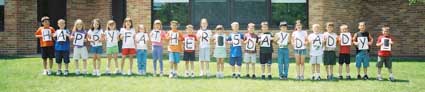
Happy Father's Day

First-grade students in Judy Bercury's class at Craneville School in Dalton have a message for fathers.

"When I was a kid, I used to imagine animals running under my bed. I told my dad, and he solved the problem quickly. He cut the legs off the bed."

- Lou Brock

Dads have traditionally been the "fixers." From the broken toaster to monsters in the closet, dads have always known just what to do to make everything right.

With Father's Day rapidly approaching, I thought dads might like to know just how significant a role they actually play in their children's lives and how little escapes their children's notice. In Dalton and Hinsdale, with great help from Craneville's first and second graders, Kittredge's kindergarteners and Kathy's Corner Daycare kids, along with their teachers and caregivers, Kathy Cormier, Judy Bercury, Suzanne Drury, Patricia Geller, Marge Morrison, Marcia Koperniak, Amy Abramovich, and Christine Verge, I found a few answers.

Do not let those glazed eyes and vacant expressions fool you: Kids are watching more than television and computer screens. When asked the questions, "What does your dad know best?" and "What has your dad taught you?" children had the following written answers - some original, some comical and some thought provoking (particularly regarding phonetic spelling) - and some Mom might not like to know:

What does your dad know best?

"How to do cartweels in the Fourth of July praed." - Jamie D.

"How to let off fireworks. Last summer, he let off all the fireworks." - Dylan S.

"How to whistle." - Samantha G.

"All about me." - Abby D.

"How to work best." - Angel.

"How to cownt to 100." Sydney S.

"How not to watch a lot of TV and to catch bugs like buterflys and worms. He knows how to keep me cumpny." - William O.

"How to make money at Cranes. He makes the dollars." - Brenna V.

"To cepe me shafh." (keep me safe) - Jeffrey V.

Bridget L. said she and her sisters were very proud of their father because, "Dad knows best how to open the pool on a hot hot day."

Possibly much to their mothers' surprise, it seems many dads know how to cook best, according to the children. For example, they know how to make "omlits" and "brakfist."

They also know a little bit about automobiles, such as:

"How to make a car." - William L.

"How to fix cars in one minute because he has lots of practice." - Michael S.

"How to drive a jeep and not do a sped lemet." - Joseph E.

Allie G. said her dad knows best "that wen I had to bye a rake for mother's day, my dad new where it was." (Note to Allie's dad: We know you'll love the new frying pan Allie's mom is planning to buy you this Father's Day.)

Taylor F. from Mrs. Bercury's class summed the whole question up for many, however:

"How to love me; how to take care of me and how to remember."

What is the most important thing your dad taught you?

"Stay away from the concrete." - Dalton, whose father is in the concrete business.

"Never talk to strayders and never go with strayders." -Jamie D.

"Everything I am now." - Nicholas.

"My dad taught me how to ski. He helps me up when I fall and he tells me to keep trying. Now I know how to ski." - Caitlin M.

"My dad taught me to be a good soccer player. But I still have prablms with my left foot. But I love him." - Katherine L.

"My dad has taught me how to play badmitten because I aked him to. That is whe I think he is a great Dad. And I love him very much." - Bethany H.

"My dad taught me to climb trees." Connor V.

"My dad taught me never say swear words and never move a video camra fast and never play with a scorpion."- Brandon R.

"My dad taught me how to say: Supercalifragilisticexpialidocious and his name is Scot."- Jocelyn L.

"To try new food like sooshy." Allie G.

"Not to pick up snakes. - Kaylena.

"How to tel the trooth and do a hand stand." - Sean K.

"My dad taught me a lot of songs like 'Country Road' and 'Imagine.' He taught me what was right and wrong. My dad gives me good advice." - Tiffany R.

"How to count money." - William.

"The chores have to get done or my mom yells." - Mike.

So, yes, dads, your kids probably do realize you haven't bought stock in the electric company, you have no desire to heat the outdoors and money doesn't grow on trees. They all no doubt appreciate that you taught them how to ride a bike, throw a ball, read a book, tie their shoes, use a fork, bait a hook, swing, share, "not to be scard of the dark" and "not to throw stuff."

And they really are listening, paying attention and, especially, watching you.

Monday, November 17, 2008

Making Hay While the Sun Shines


Published September 2005 The Advocate

Knowing trees, I understand the meaning of patience. Knowing grass, I can appreciate persistence.” Unknown

Lenox - “It all depends on the weather, and you can’t depend on the weather,” Phil Rennie said at a recent interview as he got ready to complete his haymaking for the summer.

Phil Rennie and Paul Cella, of Lenox, start their three-day competition not with a waving green flag, but with a field of waving green grass. They race, not against each other, but against a much stronger and more unpredictable adversary – the weather. Enough rain to make the field of Timothy grass grow high enough for haying is needed throughout the spring and summer. Three dry days and nights in a row are then needed to cut, dry and bale the hay to be stored in the barn for the coming winter.

In June and August almost every year for the past 15 years, Rennie and Cella have driven in circles over a 4 acre field owned by a neighbor on Holmes Road in Pittsfield. The field is one of the few undeveloped pieces of property left on that road.

Their maximum speed is less than five miles an hour. They don’t wear helmets or seatbelts, but they do make sure their boots are tied, and their sleeves are buttoned so nothing can be sucked into the machinery, causing injury.

“I’ve heard of farmers who have lost arms or legs because their shirt sleeves were too loose,” Rennie said.

Rennie and Cella don’t have wealthy sponsors or screaming fans. Their only audience is of the winged and four-legged variety - hawks, field mice and moles, and sometimes, Rennie’s 15-year-old terrier mix, Benji, who likes to play in the field.

“The moles come out because they hate the vibration of the tractors, and the hawks sit in the treetops and wait for lunch,” Rennie said.

On the first day, Cella, driving a 1948 white Oliver tractor and Rennie, driving a green 1966 Oliver tractor, both tow sickle haybines around the field. The blades of the haybine cut the grass and the circular motion pulls it through large black rollers to squeeze some of the moisture out. It then lays in the field overnight.

Tedding, the process where a tedder towed behind the tractor spreads and shakes up the grass to help it dry, usually done on the second day, wasn’t necessary this time because there had been so little rain in the month of August. Rennie said they usually get the tractors stuck in the far end of the field because it’s so swampy, but that wasn’t a problem this year.

The third day, at about 11:00 a.m., after the dew had dried, Cella towed a hay rake and windrowed the cut grass into circular rows about ten feet apart. This allows the cut grass to “catch the wind” and dry more quickly. If the grass was at least three feet high, he would have driven in a clockwise circle and pushed the rows to the outside of the field. Since the grass was only a foot high before this August cut, he drove in counterclockwise circles and pushed the grass to the inside of the field. Double “windrowing” works well to make larger piles when the grass is sparser. Larger rows mean fewer passes and less work for the baler, which will follow.

Once all the grass in the field has been piled into rows, Rennie drives his tractor, towing the baler, kicker, and hay wagon from his house on East Street in Lenox around the corner to Holmes Road and down into the field. The length from the front of the tractor to the back end of the wagon is 54 feet long. Turning the corner, Rennie is on both streets at once, while oncoming traffic in both directions on Holmes Road patiently waits.

Once Rennie reaches the field, he drives the tractor over the rows of hay, where it is sucked up into the baler, compressed into square bales and tied, by the machine, with twine. A plunger pushes each tied bale to a stainless steel square plate, called a kicker, which tosses the bales high into the air and into the back of the hay wagon. The kicker can be adjusted as the back of the wagon becomes full, to kick the bales to the front of the wagon. A counter keeps track of the number of bales kicked into the wagon.

Rennie, who has owned and run a lawn care and fertilizing business, The Lawn Doctor, for the past 17 years, does no fertilizing of the Holmes Road field, allowing Mother Nature to determine the height of the grass.

“Sometimes we bale a few weeds too, but a little roughage won’t hurt the horses. They won’t touch the goldenrod though, so you have to stay away from that,” he said, pointing out a large patch of bright yellow weeds growing at the far end of the field.

The grass, after a rainy spring, was about four feet tall for their first cut in June, which produced about four hundred 35 pound bales of hay. The second cut, at the end of August, after a summer of little rain, was only a foot high and produced only 110 bales of hay. Their “winnings” at the end of this race will be enough to feed Rennie’s three “pet” horses, Willie, Misty and Laura Lou and Cella’s horse, Gold Man when the grass stops growing in November. The hay supplements their diet of grain and occasional treats of apples and carrots.

Rennie, who bought his mother’s house, adjacent to the Holmes Road field and just over the town line in Lenox, in 1981, has lived most of his life in Lenox. Married for 34 years on October 23, 2005, to Hania Gardner of Pittsfield, he has two daughters, Kristin, a veterinarian who lives in New Hampshire and Kendra, a federal probation officer in NY. Kristin’s ten month old son, Theo, is Rennie’s first grandchild. He has owned horses all his life and first learned to cut hay with his grandfather, when he was just five years old.

“It was a lot more work back then,” he said, “In the old days, we cut it with a sickle and it would just plop on the ground. We would pitch fork it into piles and load it by hand into a wagon pulled by a horse. Then you’d pay somebody about a $1.00 an hour to jump up and down on the hay to pack it down. What used to take 15 people three days to do, can now be done in the same amount of time with just two or three people.”

“Before we had the hay wagon and the kicker, I used to buy beer for the neighborhood guys, and they’d go around the field and throw the bales onto the back of pickup trucks and help us load it into the barn. It was cheaper [for them] than joining a health club,” he said, “One guy even got mad at me for buying the kicker. He liked the workout,” Rennie said with a laugh.

The process of making haying, in addition to being ruled by the weather, can be disappointing or even dangerous. The hay cannot be cut, baled and stored in the same day because hay that is too damp will grow toxic mold, which makes it useless as livestock feed since it could kill or cripple a horse. Worse, hay packed into bales and stored too wet can spontaneously combust, which has, according to Rennie, caused most of the barn fires he’s seen.

The best feeling in the world, Rennie said, is when the hay’s all in. For him, it’s three days of peace and quiet in a sunny field where the only sounds are the drone of the tractor engine and the occasional scolding of crows. “I just like being outside,” he said.

Rennie prefers the square bales to round. He said the equipment needed to roll the hay into those big “marshmallow” shapes, is too expensive for him to justify the cost.

“The round ones are heavier and harder to handle. I think there’s more waste in the round, and I don’t think the horses like them as well. If you don’t have any help, though, round is the way to go because you can pick them up and move them with a tractor.”

Though no one applauds or sprays them with champagne when they both cross the hay making finish line at the same time, Rennie has had a corn roast the Sunday before Labor Day every year for the past 34 years. Attended by 200 people, (some of whom the Rennies don’t know, but welcome nonetheless), they buy 400 ears of corn from Whitney’s Farm in Cheshire, Massachusetts.

“It gets bigger every year. Everybody brings a dish, and we can cook 40 ears of husked corn at a time in a rack over an open fire. It takes two guys to flip the rack, and you’ve never tasted corn as good,” he said.

It wouldn’t be a real Rennie picnic, of course, without hayrides. Throughout the day, the hay serves double duty as seating for all the Rennie’s guests. From the oldest to the youngest, no one misses the chance to climb up on the hay wagon for a ride as Rennie puts his tractor to use one last time, celebrating another successful hay making season, family, friends, and the official end of summer.

Thursday, November 6, 2008

Waiters dish out realities of the service industry

Published: June 9, 2005; The Advocate & http://www.advocateweekly.com/

“Will you marry me?”

“How did you lose your thumb?”

“Could you send that girl a pink lemonade from me?”

“Can I have your phone number?”

“Have you seen my dentures?”

Along with tips, these are just a few of the tidbits servers at local restaurants have collected from customers over the past few years.

From the other side of the table during recent interviews, Applebee’s servers, Sharon Croshier, Joshua Crawford and Brett Jalbert, along with Zucchini’s employees Todd May and Crystal Czerno, dished up their experiences and a few embarrassing moments in the restaurant business.

The National Restaurant Association estimates that four out of every 10 adults have worked in the restaurant industry at some time during their lives, and 27 percent of adults got their first job experience in a restaurant. The restaurant industry, employing an estimated 12.2 million people, is second only to the government as an employer, according to the association’s Web site, http://www.restaurant.org/.

Crawford, Jalbert and May are full-time college students, working to pay tuition. Crawford and May are business majors and Jalbert is studying structural engineering. They all plan to keep their current jobs on a part time basis after graduating. Croshier, mother of an 11-year-old daughter and 6-year-old triplets, appreciates the flexible schedule and being able to go home in a good mood every day. Czerno, whose mother is also a food server, has worked in the restaurant industry since she started bussing tables at age 13 and hasn’t yet decided on a future career.
None of the five is pursuing a career as a singer. Their most embarrassing moments in their current jobs include singing happy birthday to customers.

“None of us can sing,” May said.

Crawford admitted to a lack of singing abilities as well, but one of his most embarrassing moments came when he took a stab at comedy.

“I went to take a plate from a customer, and he said he wasn’t quite done,” Crawford said. “Holding my hand up with my thumb tucked into my palm, I said, ‘Oh sorry, good thing I didn’t take it. I already lost one of my thumbs.’ And [the customer] said, ‘that’s funny, I lost my thumb ice fishing; how did you lose your thumb?’ He really had lost his thumb, and I felt like the biggest idiot. I excused myself to go get my foot out of my mouth and apologized profusely for the next half hour. At the end of dinner, his wife gave me a hug and said it was the most fun she’d ever had in a restaurant.”

“Josh is a bit of a goofball,” Applebee’s general manager, Billy Greer, said, “but we encourage that here because we want our customers to have fun.”

With over 900,000 eating establishments generating an estimated $476 billion of sales every year, restaurant patrons must be having fun. The National Restaurant Association estimates the average household expenditure for food away from home in 2002 was $910 per person. Food servers typically earn $2.63 per hour.

“It doesn’t sound that bad until you say it out loud,” May said.

“But at least it covers income taxes,” Croshier added.

“Some weeks their paychecks are so little they don’t bother to pick them up,” Greer said.

These minders of the tables, servers of food and sometimes finders of the false teeth that are inadvertently left behind after a meal, work for their tips. Though they never know from one day to the next how much money they will take home, they all agree that the instant feedback of a great tip for doing a good job is an incentive to do their job well – and a bad tip merely motivation to make improvements. The hard part, they said, is that they can’t predict or depend on a certain level of weekly income.

Croshier, who admits she lives for challenges, doesn’t think raising wages and eliminating tips is a good idea, however.

“It’s fun to earn a good tip,” she said. “It’s almost like gambling – waiting on tables is a high, and I love it. It’s up to me to make the money I need.”

Czerno said, “When you’re on your own, living in the real world, and it’s been a slow week, you start to stress and say to yourself, ‘I’d better get my game on quick, rent’s due next week.’”

Jalbert said, “Yesterday, I was ruthlessly, horribly sick, but you can’t get sick. I spent my last $10 yesterday, so I got sleep and took [my medicine} because I needed to work today.”

Crawford added, “Tips are everything. Keeping your chin up after you get a 5-percent tip is hard. You want to ask what you did wrong, but you can’t. You swallow it and go on, and maybe the next customer doubles your tip. I’ve seen people who watch another customer giving the server a bad time and try to make up for it with a bigger tip.”

May agreed that it’s hard to predict a size of a tip.

“You can completely misjudge whether or not they’ll leave a good tip, and for the most part, you can’t tell. I think people tip no matter what you do. Some people are brought up to tip 10 or 15 percent; some people bring in their calculators. Others will throw down a $20 for a $40 meal without giving it a second thought.”

Determining the size of a tip may not be possible, but servers do develop skills in evaluating and anticipating what people need and want, sometimes before they ask for it.

“The biggest part of being a successful server is learning to read faces and body language,” May said.

Czerno said it’s awkward when people come in fighting or having a bad day.

“You try hard to give them their space. I don’t see that he’s yelling at her and she’s crying, and they’re choking down their food. I don’t see that.” But, she added, “If there’s something wrong with the food or service and I don’t see that, please tell us.”

An only child, Crawford admits to little experience with young children. At 6 feet 2 inches tall, he has learned that bending down to eye level of the younger customers and giving them choices too, is appreciated, not only by the kids, but also by their parents.

Croshier said she waits on tables the way she would expect to be waited on. “If I’m eating messy wings, I would like extra napkins. If I’m halfway down on my drink, I would like another one before I have to shake my glass around wondering where you are, and I would never ever forget the silverware. Those little things are important, and you remember them when you do it day in and day out – or at least you should.”

Jalbert said learning to read faces has helped him develop his poker skills, but he admits that remembering to bring silverware to his tables is still a challenge. He and his co-workers laugh and excuse his shortcomings with some good natured teasing.

“He’s tall, so he hits his head on the Tiffany lamps a lot,” Greer laughed.

“They’re cast iron,” Jalbert added. “That hurts.”

Because both restaurants serve alcohol, their servers are also responsible to stop serving an inebriated customer. Applebee’s had an incident with a woman trying to hang from one of its Tiffany lamps after a few too many drinks.

Croshier said, “You can’t allow that. This is a family restaurant, and the other customers don’t want to see that.”

May said that, in his experience, people know when they have had too much and don’t usually get upset with the server when they have to stop serving alcohol.

All five agreed their co-workers and regular customers are their extended families and like any normal family, conflict and occasional clashes occur.

“I can be bossy,” Croshier admitted. “Because I’m a mom, I sometimes treat my co-workers like my kids.”

“We’re human,” Crawford said. “There are sometimes problems with a co-worker, but you don’t bring it into the dining room – you put on a happy face and do your job and we’ll talk about it when your shift is over.”

Greer added, “Everyone has off days and if it’s really bad, there’s a soundproof freezer in the back where you can go to scream and punch a box of French fries.”

Problems with co-workers pale in comparison to the stress of dealing with the public. Customers are allowed to be rude, condescending, demanding or just downright cranky, but dropping drinks on customer heads is never acceptable server behavior. Smiling and being polite no matter what is the golden rule for servers.

According to the serves and managers, customer complaints are almost never about service. Customers hate waiting more than anything, which may be a result of a society geared more and more to instant gratification.

Crawford observed, “One customer can’t see that I’m doing 32 other things right now. They only know their glass is empty, and they’re thirsty.”

Because they’re human, servers do get frustrated with customers. Among their pet peeves are customers who yell, snap their fingers, clap their hands or refuse to make eye contact and ignore them. May summed up the main feeling of every server, with a simple sentence, “I’m here to serve you, but I’m not your servant.”

The worst customer, of course, might be a fellow server. They all regularly go out to eat at different restaurants in the county. Croshier said she’s very critical when she eats at another restaurant, always measuring the service against her own high standards. Crawford said he likes to challenge servers by asking for “weird concoctions.”

Czerno, on the other hand, said “I would love to wait on me….it drives me crazy when I get bad service, but no matter what, I tip 20 to 30 percent because I know what it’s like to work for tips.”

Tired of cooking, weary of washing dishes, or perhaps in celebration of a special occasion, every American has probably graced a restaurant table at least once. Balancing drinks and serving food might seem deceptively easy while perusing a menu from a comfortable seat, but service with a smile is only a small part of the job of a server.

Marketing, memorizing, matchmaking, and mind reading are necessary skills, too.

“Just treat people the way you would want to be treated.” Croshier advised. “And don’t take things too seriously.”

Wednesday, November 5, 2008

For Nurse couple, love and expertise heal all wounds

Published: November 24, 2005 - The Advocate Weekly & http://www.advocateweekly.com/


When asked to guess their occupations, most people assume Bill Ahern is a truck driver, a mechanic or a plumber and they often, even without invitation, ask his wife, Brenda Ahern, if she is a nurse, because she “looks like a nurse.”

They are half right. Brenda and Bill Ahern are both registered nurses.

According to the U.S. Department of Labor, less than 10 percent of the more than two million RNs in this country in 2004 were men. Though strangers are surprised by Bill Ahern’s occupation, their reactions have always been positive. His friends and family, however, sometimes use his profession to give him a hard time. While helping his brother-in-law build his house, he was given the job of pounding 3-inch spikes into the concrete foundation.“I might be a nurse,” he said recently, “but I can pound a nail. I used to build Shaker tables and do basic carpentry, but I hadn’t ever done this before, and I kept bending the spike. One of the other guys yells, “’Hey get the nurse off that job.’”

Although he does not resemble Florence Nightingale in any way, Bill Ahern has worked within the medical community for the past 17 years. He started at Hillcrest’s dietary unit at age 16. After joining the National Guard infantry at age 19, he attended Berkshire Community College part time and continued to work at Hillcrest as a radiology transport aide and darkroom technician, and an operating room orderly, where patients often mistook him for a nurse. He also worked as an anesthesia technician at Crane Center/BMC’s operating room.

When someone first suggested he become a registered nurse, he scoffed at the idea, then realized he had completed all the prerequisite courses necessary to enter the nursing program at BCC.
Recalling his grandfather’s advice to “build on what you know,” and searching for a new challenge, he entered the program. While enrolled in the RN program at BCC full time, he worked at Berkshire Medical Center’s Dialysis Unit as a Reuse Tech and trained as a hemodialysis technician. Once he qualified as a registered nurse, he joined the Dialysis unit at BMC in the Medical Arts Complex in 2001.

Brenda Ahern, on the other hand, did not enter the nursing program until after she married four years ago, but she had considered a nursing career from the time she was a child. When she and her future husband met, she was also taking part-time classes at Berkshire Community College to become a medical assistant, and worked at Lenox’s Yankee Inn and for the advertising department at the Berkshire Eagle. Upon completing her training, she worked at Lee Family Practice as a medical assistant and phlebotomist. In 2000, she joined BMC as a medical assistant at its Neighborhood Health Clinic, while completing her prerequisites for the nursing program at Berkshire Community College. When she was accepted into the RN program, she also worked part time as a unit secretary, at BMC’s Jones-2 and as a nursing assistant in telemetry.
She became a registered nurse in 2004, and said she feels she didn’t choose the profession as much as it chose her.

“I transferred my position to nursing assistant on [Berkshire Medical Center’s] 5 West while going through the nursing program, and I felt comfortable here. It’s an honor to be there with the patients and their families, but it’s tough too,” she said. “Patients have said to me, ’How do you do this? This is a thankless job.’ But when I’m cleaning someone up or helping someone out, I like to think that someone would do it for me – that’s how you get through the hard parts of the job.”

Her husband agreed. His first “hands on” experience as a nurse-in-training was what those in the nursing profession delicately refer to as a “code brown” situation (cleaning up diarrhea). It did not deter him from his goal, however, and he still takes it all in stride.

Recalling a recent experience with a patient who kept apologizing for the situation, he joked, “Well if the shoe was on the other foot, you’d do this for me wouldn’t you? And the guy looked right at me and said, ‘no!’”

Combined with compassion, the Aherns both contend a sense of humor is absolutely necessary not only to connect with their patients and give them the best care, but to maintain the ability to love the job even on the days when they can’t seem to make anyone happy. Perhaps more than most jobs, nursing can be emotionally, mentally and physically draining, but most of the time, the couple can count on each other for support. However, being in the same occupation also has its drawbacks.

“It’s a double-edge sword,” Benda Ahern said. “I feel lucky that we’re both in the same profession because I’ve had nurses say, ‘My husband just doesn’t understand what I do.’ A lot of guys might say, ‘Well, you didn’t do a roof all day,’ but Bill knows how hard it is [to be a nurse] because he does it too.”

On the other hand, there are some days where one of them will want to vent, and the other one wants to forget about it.

“Some days I come home, and she’ll want to talk about it, and I’ll say, ‘Oh yeah? You think your day was bad? Well, listen to this,’” Bill Ahern said.

His wife replied that they occasionally face days that inspire dreams about leaving the profession, buying an inn in Vermont and opening a quilt shop.

In spite of the difficulties, both nurses said they most appreciate the aspects of the job that allow them to interact on a daily basis with a wide variety of people and personalities. Both feel the most important skill in nursing, aside from technical knowledge, is to learn to adapt to every situation, leaving any inclination to make judgments about anything other than a patients’ health and comfort outside the door.

“Every room that you walk into will be a whole different situation, and you have to figure out how to switch from one person to the next,” Brenda Ahern said. “You can’t be judgmental because you can never know why people are the way they are or how they got to this place in their lives.”

When admitted to a healthcare facility, patients may make judgments of their own, of course. Placing faith in the professionals who care for them, they often give up a certain amount of control, not to mention a bit of their dignity. Neither Ahern, however, has ever encountered patient prejudice because of their gender, and both frequently receive compliments about the other’s skills from patients they have in common.

“I’ve seen my husband interact with the patients, and he immediately puts them at ease; he is very gentle, very very patient and very kind,” Brenda Ahern praised.

Based on their experiences personally and professionally, though, both acknowledged their own stereotypical assumptions and expectations, especially about themselves and each other. Bill Ahern believes male doctors relate differently to him than they do to female nurses.

“When a doctor gets upset,” he said, “and yells because something is missed or isn’t done right, I interpret that as “Hey dude, c’mon.’ It motivates me to do a better job, where Brenda would probably take it more personally.

She didn’t disagree, and offered some of her own observations about the male of the species.
“He cut his finger with my manicure scissors while we were on vacation. I told him to be careful. I told him they were really sharp. He should have had stitches, but he wouldn’t go to the hospital. He used duct tape, which he carries with him everywhere we go. He’s a big baby when he gets a cold though.”

Despite, or perhaps due to, the responsibilities of their jobs, the couple said they are more appreciative of each other, and feel free to be as open and honest as the people they care for.

“When you’re seriously ill, you say exactly what you think,” said Brenda Ahern. “It’s freeing in a way. I always tell people, if something hurts, and they need to swear, I’m not offended – whatever they have to do to make themselves feel better, it’s okay.”

The job has changed their perspectives and attitudes about life in general, as well.

“When I’m upset over something like a boat part didn’t come in, and I need to put it on the damn boat, I’ll think about a patient I’m taking care of, and my problem is like nothing,” Bill Ahern said.

His wife added, “I realize that I get to go home and forget about it for awhile and lead my life. But they’re sick and can’t get a reprieve. It makes us more grateful and take things less for granted.”
The Aherns take seriously their roles as the people who assess and report, educate, advocate, and rehabilitate, hold hands and heads, reduce pain, promote healing, clean up, calm down, and provide comfort in even the most uncomfortable of situations. And as experts in their field, they have a unique understanding of nursing’s challenges and problems.

One of the biggest issues with regard to quality care, they said, is not a shortage of people eager to enter the field of nursing, but a lack of qualified nursing teachers and nurses available to give clinical instruction.

And although they have been discouraged at times, they are both grateful to have made it through the “fear phase” of nursing, where they began to believe they had the symptoms of every illness they studied; and the “honeymoon phase” of nursing when they believed perfection was possible. And they try to take care of themselves and abstain from becoming cynical about the illnesses they see all around them.

“People educate themselves more about buying a car than [they do] about their own health,” Bill Ahern said.

Brenda Ahern agreed. “Doctors aren’t God. Don’t be afraid to say, ‘explain that further’ or ‘I want a second opinion.’ The patients’ participation in overall heath care would help immensely.”


But leave the duct taping to the professionals.

Friday, October 31, 2008

Local woman finds plumbing far from a draining experience


“Energy and persistence conquer all things.” Benjamin Franklin (1706-1790)

Published The Advocate Weekly February 24, 2005

Becket – The sink’s backed up. The pipe just burst. The dog is treading water in the dining room.

Any of those unfortunate events prompts a frantic call to a plumber – typically a grizzled guy in heavy work boots and a dusty cap, whose tool belt doesn’t quite hold up his pants. If, instead, beauty, brains and a wellspring of cheerful personality knocks on the door, armed with her own well-fitted tool belt, cap and work boots, the average plumbing disaster victim might be surprised.

Julie Gardner represents part of the 1-to-2 percent of female plumbers out of the roughly 420,000 plumbers in the United States. She lives in Lanesboro and works for Cesco Plumbing in Becket, owned and operated by Christopher Swindlehurst, master plumber.

Gardner, interviewed last week after a full day’s work that included reading blueprints, wielding a jackhammer, drilling holes, swinging a hammer, consulting with an electrician and a contractor, and fitting pipe while managing a residential bathroom-remodeling job, is not just a typical plumber. She, too, is a master plumber – a level of licensing in the plumbing industry that many men may never achieve or even aspire to.

In 1994, at age 23, Gardner registered as an apprentice plumber, which required working alongside a journeyman or master plumber for at least three years – “where you start greener than green,” Gardner said.

After that time, an apprentice plumber may apply for a journeyman plumber’s license, which requires 6000 working hours and 300 classroom hours. An additional 2000 working and 100 classroom hours fulfills the requirements for a master plumber’s license.

Plumbing is not a glamorous job, nor a particularly clean one. It is, however, “always a challenge” said Gardner. Having grown up as the baby in a family of four sisters and a brother and never having attempted anything without plunging into it (so to speak) wholeheartedly, she acknowledged loving a challenge.

While attending C.H. McCann Technical School in North Adams and Taconic High School in Pittsfield, Gardner held jobs at the former Waverly Fabrics in Adams, Domino’s Pizza and the former Sprague Commonwealth Capacitor in North Adams. She graduated from McCann in 1991, completing a course then known as retailing/business careers, and finished her plumbing theory course at Taconic in 1994. She said she got good grades at McCann but developed an urge to work outside an office setting and was trying to decide what she wanted to be “when she grew up.”

When Dominos offered her management training, she politely declined and looked for a job requiring more thinking and offering “fewer night hours, better advancement opportunities and time for a social life.”

Thanks to “timing, luck and affirmative action programs,” Gardner took a job with her brother-in-law, David Ziarnik, a head mechanic at Adams Plumbing Co., as an apprentice plumber. Her first responsibility on the job she held for six years was a “firewatcher” on a project at Martin Marietta in Pittsfield installing factory chiller units. The welder’s job was to weld pipe. Gardner’s job was to watch the welder and to make sure nothing caught fire. Ziarnik, understanding the boredom of this necessary part of the job and the learning process, gave Gardner the second set of tools she would need to become a plumber – the Massachusetts plumbing codebook and the “Plumbers and Pipefitters” Handbook.”

Gardner said she feels at ease working in a male-dominated field. She was labeled a tomboy growing up, she said, “Because I was always outside with my brother, Arthur, shooting the BB gun, building bicycles and playing with trucks instead of dolls.” She admitted she liked being different.

“I even played youth football and Little League on boys’ teams, which made; me a stronger player, mentally, when I had to play on the girls’ teams,” she said.

Those experiences gave her an edge, she said, not only in competitive sports, but also in the plumbing business, where mental ability is just as necessary as physical ability.

Being a woman in a male-dominated field hasn’t’ been “all puffy clouds and rainbows,” she said.

“People don’t like change, and I had to prove myself.”

When people are less than accepting of her career choice, she recalls a comment she overheard when she played football. “A parent said, ‘You shouldn’t be on the team because you’re taking the position away from a boy.’” Gardner replied, “That’s why we have tryouts.”

Her attitude today is, “Everybody has a right to earn a living, and I have a right to choose this.”

Her fiancé, Peter Morandi, who used to work in construction but is now an IT technician, is her biggest supporter. Her family has also been encouraging because, she said, “They would always know where to find a plumber when they needed one.”

Gardner said she attempts to overcome people’s initial apprehension with her self-confident, positive attitude, which she attributes to the career itself.
“When I first meet a customer, I shake their hand and ask, “hey how you doing? I’m your plumber. What do you need? What questions do you have?’ And I can see their relief.”

When asked for plumbing advice, Gardner offers two rules for the average person: 1. “If you don’t have the knowledge and don’t understand the rules, don’t attempt the job on your own.” 2. “Don’t use drain cleaners; they cause more problems than they solve.”

People sometimes take plumbing too lightly, she said.

“I don’t want to discourage people from attempting their own small plumbing jobs, but the reason Massachusetts is so strict about plumbing codes is because people can die from plumbing mistakes. Water distribution and waste disposal have to be done correctly.” [An improper water distribution system can lead to contaminated drinking water, while waste disposal problems can result in disease-causing bacteria.]

Both Swindlehurst and Gardner agreed the plumbers they know all have diverse levels of experience and personalities. However, dealing with emergencies every day in a sometimes dirty, always extremely safety-conscious business, all successful plumbers share two important traits, Gardner said.

“We are all stubborn because we can’t just walk away from a job until it’s finished,” and “We all have to be good natured. How else could we burn ourselves, crawl in the muck, deliver bad news, deal with daily disasters, see the worst of the worst and still come back to work every day?”

They also agreed that the best things about the job are “the people you meet, all the coffee you can drink and the ultimate satisfaction of solving a problem with a job well done.”

“We like the thank-you letters,” Swindlehurst added.

“But if we don’t hear back from the customer, we know we did it right, and that’s a good thing, too,” Gardner said.

She doesn’t like stereotypical labels and laughs at the irony when she described herself.

“I like my sports – playing and watching – and I don’t like to shop or dress up, but I did fix up my hair and wear a nice dress to the office Christmas party a few years ago.” She recalled the reaction of Michelle Lampro, a co-worker of eight months. “She sat across the table from me all night, wondering who I was and why I was there.”

She said she plans to stay in the business because “I’m stubborn, it’s a good living, I like nice things and vacations, and you have to earn that.”

Swindlehurst and Gardner offered the same advice to anyone considering a plunge into the plumbing business: “Do it. We need the help.”

Thursday, October 30, 2008

WBEC's 'natural' takes reins at new WUPE


Published August 26, 2004: The Advocate Weekly & www.iberkshires.com

“All you need is love.” John Lennon and Paul McCartney

“I met Paul McCartney a couple of years ago at his Off the Ground tour in New York City. I touched him. I remember my mouth opening, but I don’t remember any words coming out. I was completely star struck, but I can die happy now.”

So said Joanne Billow, WUPE’s new morning radio DJ, during an interview last week. Billow, possibly best known in the Berkshires as the most popular radio personality of Pittsfield’s largest radio station, WBEC (Live 105.5) previously considered the morning show there “her baby.”

VOX Corp., already the owner of five of the nine local radio stations, was in negotiation and awaiting FCC approval to purchase two more stations in 2004. Rumors flew, and speculation was rampant as to what would happen to “small town” programming and well-known radio hosts when and if the sales became final. VOX purchased WBEC AM and FM in December 2002 and WNAW and WMNB in North Adams and WSBS in Great Barrington in May 2003. The sale of WUPE and WUHN was final in December 2003.

“We didn’t really know anything,” Billow said. “When I was called into the office earlier this year, I thought I might be getting fired. When they told me I was going to WUPE, I was happy. I love that kind of music (oldies). But I was sad to leave WBEC; that was my blood, sweat and tears for 19 years.”

She admitted being very emotional the day she left WBEC for good. Of course, she also confessed that almost any movie makes her cry, including “The Nutty Professor,” because she gets lost in the emotions and caught up in the characters. However, with her usual upbeat manner and cheerful good humor, Billow feels she is adjusting well to her new job.

“The best thing about this job is leaving at noon and having the whole day left to enjoy,” she said. “But I hate hearing that alarm go off at 3:30 every morning. “ Larry (Kratka) is a great guy – we dance and sing along with the music – we’re like family here.” Kratka is news director for the Berkshire News Network and has the same hours as Billow, 5:30 to noon.

Born and raised in Shaftsbury, Vt., Billow is the only daughter of John and Henrietta Billow – her first family. The senior Billows still live in Shaftsbury and work at their small real estate office there, and Billow likes being close enough to visit them on a regular basis.

Her childhood memories do not include hearing “get your buns out of bed,” a well-known Billow radio phrase.

“That just slipped out one morning, and it sounded good so I thought I’d keep using it,” she said.

She does recount family trips to Cape Cod and Canada as some of her happiest memories, and she still likes to travel as much as possible in her free time.

“Someday, I want to travel to Alaska, see the majestic views and the Northern Lights, possibly on my honeymoon, and preferably, married to Paul McCartney.”

Billow has remained single but said she has no regrets. “I have work I love. I do what I want, I’m independent and self sufficient, and I live close to my family,” she said.

Her family also includes a brother, younger by 18 months, a sister-in-law, Denise, whom Billow describes as “a gift to our family,” a niece, age 4 and a nephew, almost 7, whom she treats as her own children.

“Those kids are my life,” she cheerfully acknowledged. “I would die for those kids. You don’t have to have children to love them, enjoy them and be part of their lives.” [She declined to name the children for this article in respect to their parents’ wishes.] On her nephew’s 1st birthday, her gift to him was a photo album of 52 pictures that she had taken – one for each week of his life. “I’ll never forget the look of surprise on my brother’s face,” she said. “’You were at our house every week?’ he says. ‘Duh, I said,’”

Billow, who would like to be a professional photographer in her next life, did not set out to be a radio personality. “When I was in high school, if you were female and you didn’t want to be a nurse, homemaker, teacher or secretary, they didn’t know what to do with you. They asked me what I liked. I said, ‘art.’ They said, ‘Well, you should be a nurse, then.’”

Dutifully following directions, Billow became a candy striper and then a nurses’ aide, while in high school. She even enrolled in the four-year nursing program at St. Anselm in New Hampshire. “I flunked logic,” she said, “And I soon realized that good bedside manner wasn’t going to be enough to keep me there.” Since she was young, loved to travel, was not currently enrolled in college and was not really sure what she wanted to do, Billow ended up in the restaurant business, as a waitress and bartender, “following the money.” She worked at resorts in southern Maine, northern Vermont, New York, Florida, and South Carolina but soon tired of the pace, packing and moving every few months. Listening to a favorite radio station out of New Haven, Conn., WPLR, one day, she heard an advertisement for the Connecticut School of Broadcasting.

“I thought, wouldn’t that be the greatest job in the world? So, I went down and auditioned. They loved me and I loved them. They told me I was a natural, so I decided to go for it.”

Her first job was reading the news on WJOY/WQCR, a Burlington, Vt., station, for a year. After training herself to be a DJ, she was awarded the night job on WJOY, playing 45s for four years. WBEC was her second job in radio, first on its 1420 AM station mid-days, and then replacing Rick Beltaire when he moved to WBRK. Simulcasting WBEC AM and ROCK 105 for a year, she then moved to ROCK 105 exclusively. She loves to hear people call it Rock 105 today because “it means they have been with us for a long time.”

She left her radio career briefly in 1989 to sell life insurance, but the economy took a nosedive shortly thereafter, and she went back into radio in Glens Falls and WGBY in Albany, N.Y., until 1991. “My old boss called me in ’91 and said, “We need you, Jo Jo. Come on home.’ Bob Howard owned the stations then, and he made me the program director.”

Other than getting up earlier and feeling less performance anxiety, Billow said her life as a local radio personality has not changed much at WUPE. She loves her work and the freedom the owners give her to be inventive.

Although the show is strictly formatted and largely computerized, she has creative license to fill it up with her own themes, contests, guests and songs. She continues to manage the Web page for WBEC and will soon have a Web page for WUPE, which she will maintain as well. Her responsibilities include being involved in all aspects of commercial production, writing the copy, coordinating the public service announcements, scheduling guests, producing the morning show and always trying to “push the right buttons, even if I seem like a floppy fish some mornings.”

“It helps to have everything planned, written and in place so you know what you’re doing next, but you need to remain flexible because things come up,” she said. “Very important: Always have a Plan B in case things don’t work out the way you thought they were going to.”

At times, even her words do not come out the way she thinks they will. She recounted as one of her most embarrassing moments the day she said, “St. Mary’s will be serving sloppy Jews for lunch” instead of “sloppy Joes.” It was almost as bad, she said as the day of the “Van Incident.” Trying not to laugh, she shared the story.

“It was awful. I had drive the WBEC van to Park Square for ‘picnic in the park’ that day at lunchtime. I had been there awhile and someone said to me, ’Joanne, who’s driving the van?’ Well, I am, of course. I look over and see the van across the street on the lawn of the courthouse – just hanging there on the curb. It was surreal for a moment because I couldn’t figure out how it got over there – across four lanes of highway at high noon, where drivers don’t even stop for pedestrians. I go over and get in, but it’s hung up, so I can’t drive it off the curb, and everybody in the whole courthouse is now hanging out the windows and out on the lawn laughing at me. A cop drives by and yells, ‘Hey! You in the van – hands up.’ I read in the paper the next day, ‘Billow not cited,’ which is when it first occurred to me I could have gotten a ticket for forgetting to put the van in park.”

She remains good-natured, but she does value her privacy. “When you’re in the public eye, no one lets you forget any of your boo boos,” she said.

She hesitates to give advice to people who want a job in radio because of the whirlwind pace at which it seems to be changing. Instead, she offered general advice to everyone:

“Get your degree, just be you, and follow your heart, wherever it leads – radio, brain surgery, being a mommy. Just go for it, and don’t be afraid to change your mind 10 times. The world is your oyster.”

She said she has followed her own advice and feels content with her choices and safe with her “little guardian angel with the cute buns” watching over her.

“We all want to be loved, and with this job, in this community, I feel loved. Who needs a man?” she said, with her familiar laugh. Billow said she still believes the Beatles: “Love is all you need.”

Wednesday, October 29, 2008

Joe White - Wireman


Published 3-30-06 The Advocate Weekley

A dinosaur guards Joe White’s front door, and 11 rats inhabit his living room. He has piloted a UFO, he rides a 6-foot tall bicycle; and he never leaves home without a pair of pliers and a roll of wire – especially if he’s going to an airport or a doctor’s office.

Clearly, Joe White is not your average Joe.

Or is he? White has lived in Berkshire County since he was born in Pittsfield 46 years ago, and he has worked at Crane & Company for the past 19 years. He owns a home, lives with his girlfriend, Karen, and supports a daughter, Natalie, whom he has raised to be a well-adjusted, productive college student.

White, who describes himself as typically atypical, has over the years, made people laugh, made them think and, on occasion, made them call the police. But he is not a comedian, a teacher or a criminal. He is part artist, part inventor and part practical joker, depending on the day and the perspective of his audience.

White, whose artwork includes life-size mechanical robots that have sold for as much as $1,200, is perhaps best known for his small signature pieces – his “wireman creations.” With 11 feet of copper, steel or bronze wire, a pair of pliers and 23 minutes of spare time, “The Wireman,” can create curiously lifelike 3-inch-tall wire sculptures that resemble human beings.

White said he got his inspiration while waiting to be laid off when the factory he had worked at was getting ready to close more than 20 years ago. With no work to do, and never able to sit quietly, he used a pair of pliers to bend, twist and connect a handful of garbage twist ties into a miniature piece of art that has since evolved into his wiremen – as well as his artistic “calling card.”

“I’m kind of a wire junkie,” he said during a recent interview. “I always have it around in case I get bored. I have pliers at home, at work, in my truck – everywhere I might have to kill time.”

Waiting, something most people find exasperating, has the opposite effect on White. Rather than causing impatience or tension, it provides him with windows of creative opportunities and a way to make a positive connection with people. He has made and given away thousands of wiremen over the years to people from all over the United States as well as Sweden, China, Japan, Ireland, England, Germany and Ukraine. Whether or not he can speak a person’s language, the gift of a wireman has opened the door to friendship.

His passion for wire has, on occasion, though, produced some tense moments. Twisting a wireman together at an airport a few years ago, on his way to Florida, a fellow passenger pointed him out to airport security as a potential terrorist threat.

“They searched me and started going through my briefcase,” he recalled. “I showed them what I was doing and said, ‘Look, man: this kills 20 minutes and I’ll have four wiremen when we land – this is how I spend my time.’ They were cool about it and realized I wasn’t a terrorist.”

He especially likes to leave his wiremen holding his tip at restaurants (if the service has been particularly good), and he will often give them to the parents of children who are particularly well behaved in public.

“If I see kids keeping themselves occupied while mom or dad is busy, I think they should be rewarded for that,” he said.

His childlike enthusiasm still intact, tempered by wry cynicism, White, wiry and loose limbed and somewhat resembling his wiremen creations, recalled his own childhood, noting that while money might have been in short supply, encouragement from his parents and stepfather was always plentiful.

His mother, Jeannette Lampro, a surgical technician who died in 2000, taught him about the natural world and helped him learn to sew when he was 8. His father, Russel White, a 36-year employee of Crane and Company, who died in 1999, taught him the value of hard work and gave him his own space in the backyard to experiment.

“It was my burn zone,” White said. “No matter what I did in my zone, it was OK, and that took the pressure off – I didn’t have to sneak or hide.”

His father did get a little upset, however, when White’s attempt to make a still for moonshine literally blew up, rattling all the windows in the neighborhood.

“I wanted to know how it worked, and no one would tell me,” White said. “My dad just said, ‘Joe, you can’t be blowing up the backyard.’”

He said his stepfather, Ken Lampro, taught him how to think.

“My stepfather never gave me an answer – he always made me figure it out. He said, ‘I could just give you all the answers, but then you’d be a dumbass. The things you learn and the mistakes you make will help you in figuring other stuff out, and eventually, whenever you have a situation, you’ll have a solution down, somewhere.’”

White’s older brother, Kenny, was another story.

“Basically, everything I did was because he told me I couldn’t do it,” White said. “If I wanted a boat, I’d build a boat. If I wanted a five-man bike, I’d build one. Whatever I wanted – if I could figure out how it worked – I could have it.”

He said his younger brother, Ed, was his most willing accomplice – always the first to try out anything he made, no matter how imperfect (or dangerous) it might be.

Once he had mastered land and water vehicles, of course, and like most kids, White wanted to fly.

“We used to jump off the roof with those big picnic table umbrellas, and we found that if you ripped the stitching out of the top and let air flow through, it didn’t rock so bad on the way down.”

All of his experiments with flight were not so successful. As an adult, White built a hang glider and flew it from the high school track at Taconic to the parking lot, where he left it, along with his longing to fly.

“I understood the concept, but I used the wrong kind of cable, so when I yanked the controls, I actually got play in it and nothing happened – I was either diving or stalling, and it kept taking me up higher, and I kept thinking, ‘ I just want to go down like a paper airplane.’”

“Flight,” he admitted, “scares me, but I think maybe I’m going to do it again when I’m 50.”

His next experiment after the hang glider also involved flight, but, lessening the danger to himself, he made his own UFO and flew it while standing on Earth. With black helium balloons and battery-powered flashing lights attached to fishing line, he floated his UFO out into the night sky and reeled it back in. He said even a slight breeze would make it bounce around, simulating the erratic flight of a typical UFO.

Laughing, he said, he listened to his neighbors exclaim, “Look, there it is; here it comes again!” When someone called the police to report the sighting, White said, “The Dalton cops knew who I was and where I lived and to look the other way.”

Admitting to an irrepressible prankster side, White recalled another time the police were called. His daughter, Natalie, helped him create a plaster of Paris model of his head. He covered it in a latex rubber face and set it atop a mannequin, placing it into a kayak (which he also made) that he anchored in the Housatonic River in Dalton. It looked so lifelike that people were not only speaking to it but also believing that it spoke to them. When it wouldn’t answer or move, they became concerned and called the police, who (by now familiar with his work) contacted White.

When he placed the same mannequin and kayak in a pond off the Aushuwillticook bike trail in Cheshire, though, it spoke to people in a different way. Biking on the trail one day with his daughter, White stopped to check on it and was engaged in conversation by a woman jogging by. The jogger, who didn’t realize she was speaking to the creator, asked him what he thought of it. White, interest in the woman’s opinions, told her he thought it was just a guy in a kayak. She explained to him that it wasn’t just a guy in a kayak but water sculpture – and argued its artistic merits to him. With a straight face, he continued to disagree and never did introduce himself.

His favorite art critic, though, was a 3-year-old neighbor, Steven.

“He would come over and check out my work and tell me, ‘I like this one’ or ‘This one is happy’ or, once he asked me, ‘Joe why is your art so dark?’ I could ask him what he thought, and he would never hold back his opinion or worry that I’d get upset. That was the coolest thing.”

Not everyone understands or appreciates White’s artwork.

“Some people call what I do vigilante art, but there’s no right, and no wrong,” he said. “Your art is freedom. You can do it, and if somebody doesn’t like it, they can’t say it’s wrong. You put stuff out just to make people laugh or think. It expands people’s minds. I’ve been told I shouldn’t do that – that it’s not my job. But whose job is it?”

Some of White’s artwork, including his mechanical dinosaur, may be viewed in front of his home on Onota Street in Pittsfield. White himself is easily recognizable by the height of his bicycle, the rat riding on his shoulder or the number of soap bubbles streaming from the exhaust pipe of his pick up truck. He may be contacted at
wiremanmaker@aol.com.

Tuesday, October 28, 2008

Declaration of Writing

When a mental writer’s cramp attacks, a writer must learn to set his red pencil down and walk away with dignity intact and temper in check, with the knowledge that tomorrow will be a different day, not everyone is meant to be the next J.K. Rowling, and chocolate might not make you a better writer, but it will make you a happier one. Keeping that in mind, along with a decent respect for the opinions of readers, editors and publishers, requires that writers should declare the causes which compel them to continue putting their words down on paper, in the everlasting hopes that someone someday, somewhere, will read them with at least a modicum of enjoyment, and perhaps, respect.

A writer’s truths are not always self evident or obvious, and all writers are not created equal. Whether they earn millions of loyal fans and dollars, and wallow in perpetual peace and pleasure or just enough to be blissfully happy and fulfilled at the thought of not only keeping baloney in the meat compartment, and toilet paper on the roll, but being paid to give in to their passionate urges on a daily basis, all writers are endowed by their Creator with specific undeniable desires, among them, checks that clear at first deposit, freedom from absentmindedly answering the door in our pajamas at 4 in the afternoon, and the pursuit of publication. To secure these desires, (Publishers are instituted among writers, deriving their powers from the consent of the readers) – that whenever any writer becomes overwhelmed by the process of publication – these writers must alter negative thinking and abolish insecurities, while overcoming the itch to self-flagellate at every rejection, as we scratch out our existence as writers.

Whenever we become self destructive, it will become our responsibility to Institute a policy whereby we are not allowed to visit the refrigerator until we have written at least one page, we shall not ever chat on the phone, file our fingernails, or play solitaire on the computer while we are writing, sneaking peeks at the latest stack of best sellers we picked up at the library, when we were pretending to visit it on the guise of a need to do some research. While laying a foundation of sound and realistic principles and organizing our office space or junk drawer only as a last resort and never to avoid writing. It is not a means to an end but saying what we mean where and when we mean to and to stop being mean to other writers when they are published more often or for more money than we are.

When our mind is as blank as our computer screen, and we need something to drop into it as soon as possible or prior to our next deadline, whichever comes first, we will keep writing through the muck until we find a slice of if not brilliance, at the very least, competence. If the situation becomes desperate, we may go for a walk, listen to music, visit a good friend, read an issue of Writer’s Digest or savor a sliver of really creamy chocolate. We may not sort whites from colors, check out bargains on Ebay, email forwards or watch daytime television.

Saturday, October 25, 2008

Gould Farm: 92 Years of Growing Minds & Matter

“By serving each other we become truly free.” – Carved in stone at the entrance to the Harvest Barn at Gould Farm.

Published September 1, 2005; The Advocate & www.advocateweekly.com

MONTEREY – Of the more than two million farms in operation in the United States today, Gould Farm may be the only one that intentionally cultivates happier, healthier, more productive people along with its produce.

In additional to its fruits and vegetables, Gould Farm harvests hope for the people who come to the farm for help in managing mental illness.

The farm was established in 1912, when William and Agnes Gould bought the property for $4,500. Little of the land seemed to be good for farming, and the house was all but uninhabitable, with a leaking roof, broken windows and no plumbing, telephone, lighting or heating system. But the Goulds, a devoutly religious couple, had faith in their ability to make it work.

Their goal was not only to create, and work, a productive farm, but also to help people with mental illnesses and social challenges become productive members of society by rehabilitating themselves. The Goulds would do this by welcoming those individuals onto their farm and into their home as part of their family. Like any family in the early 1900s, every member would be responsible for the work necessary for simple survival. The secret, the Goulds believed, to revealing and nurturing every individual’s value was first, to trust that it was there, and second to give it the freedom to grow, with physically demanding farm work and, when the work was done, a healthy dose of fun.

Over the next 92 years, their farm grew to 650 acres, and its “family” now consists of 100 or more people living, working and thriving.

The Goulds never had children of their own. The farm’s inhabitants became part of the Gould family, not by lineage, but by living the Goulds’ original dream. The members of the community include paid staff, many of whom have been there for more than 10 years, volunteers, who commit to 12 to 23 months of service in exchange for room, board, health benefits and a small monthly stipend, and guests, who stay from six months to three years and for whom work is part of their therapy.

Follow-up studies, and interviews with former guests indicate a high level of success. A number of similar programs have been established around the country, with guidance from the staff at Gould Farm.

Twenty-three-year-old Ben Kreider, from a small town outside Reading, Pa., has been a volunteer at Gould Farm since November 2004. A graduate of the Indiana University of Pennsylvania, with a degree in psychology, he has committed to one year of service in exchange for something that, to Kreider, defies simple description.

“My friends don’t understand what I’m doing, and I can’t explain it to them,” he said. “You have to experience it to understand it.”

Understanding may be one of the keys that unlock the secrets to Gould Farm’s success. A heartfelt compassion for others is another, and a capacity for physical labor doesn’t hurt either. There are seven work teams on the farm: Forestry and Grounds, Roadside, Harvest Barn, Kitchen, Maintenance, Farm, and Garden. Each of the teams includes staff, volunteers and guests. The members may vary each day, depending on the needs of the guests and the needs of the farm.

“Along with traditional therapy, the focus of the treatment is work, and teaching skills that will help the guests transition back into mainstream society,” Rita Kasky, Gould Farm’s development director, said. “But it isn’t ‘make-work;’ it’s real work to help run the farm, and [at the same time] it builds socialization skills and self esteem.”

The work also provides the majority of food for the people who live at Gould Farm, as well as additional income from its roadside farm stand and the breakfast and lunch service at the roadside store and café.

Mark Murray, who has recently been promoted from volunteer to staff, agreed.

“Physical activities and being out in nature are good for the mind and spirit,” he said. “I think one of the things people struggle with when they have a mental illness is staying active. Here, having hobbies and thinking about something outside of themselves replace passive activities like sleeping a lot or watching too much TV.”

There isn’t much time for passivity on a farm. A typical day for everyone starts at 7:30 a.m. with breakfast in the cavernous dining hall. A morning meeting follows at 8:05 with discussions of the weather, the day’s news, activities and assignments, a brief spiritual reading or poem and a song. The teams then meet individually and get to work at their assigned tasks.

These tasks include caring for the livestock, tending the vegetable and flower gardens, tapping trees for maple syrup, pressing apples for cider, chopping wood, mending equipment and preparing three meals a day for the community’s members. Lunch is from noon to 1, followed by another short meeting. Afternoon work is followed by 4 o’clock teatime (the apple mint tea comes from the farm’s own “tea house,” where it is crumbled and ironed into bags), and free time is from 4:30 to 6, when the cowbell rings everyone to dinner. Being late to dinner is frowned upon but is not usually a problem, since Chef Flavio is just as celebrated for his abilities in the Gould Farm kitchen as he was in his former position at a well-known New York City restaurant.

The farm never lacks for entertaining activities. There are trips to the community center in Great Barrington, theater and concert outings, hikes on the farm’s many trails and bonfires followed by swimming in the farm’s pond (even in the winter, although Kreider said it’s harder to get people to swim in the pond when they have to chip a hole in the ice first). Then it’s group games in the dining hall.

One of the Gould’s original guests, Roma, who has lived at the farm since she was 16, leads a game called Pick.

“She uses Scrabble pieces to make words, and when you’ve used all the letters, you have to make up a story from the words – that’s a fun activity – she’s sharp,” Kreider said of Roma, whom he guessed is 93.

Kreider, who works mainly on the maintenance crew and fills in wherever and whenever needed, said he loves the farming life but will most miss the people of Gould Farm when his one-year stay comes to an end.

“I’ve gotten a better understanding of the challenges people face – not just the guests but the staff and volunteers too – and how hard some things are for people to master,” he said. “Before, I didn’t have much of an understanding of mental illness – some have social issues, and it hurts them to be around people. Our conversations have given me insight: You have to try to talk, even when you don’t feel like it, as a ‘hello’ to deeper issues.”

Gould Farm gained non-profit 501C3 status in 1925 and has an external board of directors. The farm’s executive director of four years, Cate Tower, lives on the property and the original farmhouse serves as administrative staff offices. Although the farm has evolved and changed over the past 92 years, with improved farming methods, more stringent laws and better drugs for schizophrenia and depression, many things have remained the same. Every day brings something to be fed, fixed or funded, and the level of trust and genuine concern for others in the community has not diminished.

“You have guests being taught how to use power tools and doing everything everyone else would do,” Kreider said. “There’s a very high level of trust that things are going to happen correctly or that someone is going to do the right thing in a situation instead of assuming that they’re going to do the wrong things first.”

According to Kasky, there is never a lack of volunteer applications from all over the world. The farm receives referrals from AmeriCorp and Brethren Volunteer Services as well as word of mouth and the Internet.

“A lot of the volunteers come, decide to stay for awhile and apply for staff positions as they become available,” she said.

It isn’t always perfection in paradise, of course. Kasky herself lives away from the farm because she prefers the separation it provides.

“It can be like living in a fishbowl,” she said. “[But] it’s a terrific place to raise kids because they get to experience a variety of people all the time, and the stigma of mental illness is never there. It’s just a problem some people have. We are a very normal community. There are boundaries and rules, just as there are with any community.”

Although the farm operates on a fee-for-service basis, families whose financial resources are limited are not turned away if they are clinically suited for the program. Financial aid is available to families when appropriate.

Both Will Gould, who died in 1925 fighting a fire on the farm, and Agnes Gould, who died in 1958, left not only a farming community but also an ongoing legacy of hope. Their dream remains intact, and the Gould “family” keeps the spirit of the farm and its founders alive every day by living with and “serving each other.”

More information about Gould Farm may be found at www.gouldfarm.org, by writing to Gould Farm, P.O. Box 157, Monterey, MA 01245-0157, or by calling (413) 528-1804.